
Wednesday, 16 November 2016

Tuesday, 15 November 2016
HOMES Layout Tour - Jim Ellis's Southern Ontario Layout...by Don Janes
 |
| Several of Jim's steam engines wait their next assignment around Jim's Scratchbuilt roundhouse |
CNR and CPR Steam Rules On This Layout
As mentioned in an early post by George, we took in the
Homes layout tour in the Niagara Peninsula on Nov.5. We were very impressed with the layouts we saw and the quality of workmanship that went into them. Each one had a distinct theme and style of
modelling. I can’t help but notice how
more and more people are leaning towards prototype modelling, whether it be a
class one railroad or branch or short line railroad. We saw layouts that followed prototype
railroads quite closely including BC Rail, D&RGW, NS and Canadian
Pacific/ACR.
One of the more
generic layouts, but one that featured several “Layout Design Elements” (as Tony Koester calls them)
was Jim Ellis’s layout in Beamsville based around Southern Ontario scenes
featuring CNR and CPR protoypes. Jim’s
layout looks to be about 100 % complete with very impressive scenery and
structures, several built to represent actual buildings in Southern Ontario.
One of the other things that really impressed me was Jim’s collection of brass
Canadian National and Canadian Pacific steam locomotives, many modified to
represent models that aren’t available off the shelf. Not only did they look
fantastic, they ran beautifully and were DCC/sound equipped as well. He also had an impressive collection of
passenger and freight equipment. Many of
his passenger cars were built from prototype specific BGR resin kits.
 |
| Another view of the engine terminal and some of Jim's good looking equipment |
 |
| This waterfront scene features a Sylvan Scale Models resin kit of a Great Lakes freighter |
Jim’s structures
were equally as impressive, many being scratchbuilt or kitbashed to represent
actual structures that existed in the area he models. A couple examples are the CNR Grimsby station
and the Gooderham Worts Distillery that still stands in Toronto’s Distillery
District today.
Jim was a
gracious host and was very willing to share his modelling techniques. I looks forward to returning to Jim’s layout
someday for a second look when I can spend more time taking it all in.
 |
| The Gooderham & Wortz Distillery was scratchbuilt and the prototype structure still stands in Toronto. |
 |
| The Grimsby Station was built from an Imagine That laser cut wood kit. |
 |
| The layout is full of well detailed scenes like this coal dealer, a common scene in the 1950's. An early piggyback train is going by in the background. |
 |
| Here we see an overall view of the passenger station with coach yard beside the busy freight yard. |
 |
| This photo shows a couple of Jim's CNR express cars built from BGR resin kits. They are excellent models of the prototype. |
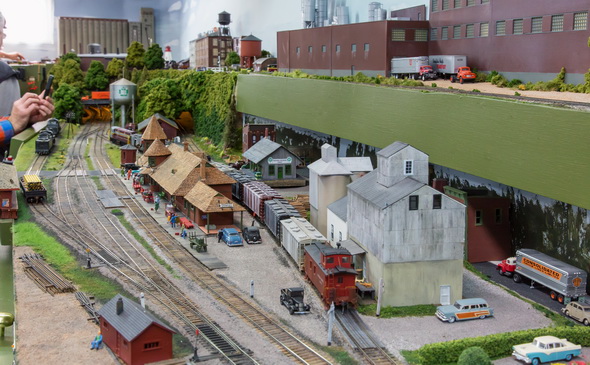 |
| Here is another view of the Grimsby Station and surrounding industries. Note that this layout is double deck on this side of the room. |
 |
| This fully sceniced swing bridge allows easy access to the layout and works flawlessly. |
Monday, 14 November 2016
HOMES Layout - Hamilton, Ont.
 |
| The Hamilton, Ont. TH&B station. Another view of this station was seen in my last Sunday post. |
 |
| On a peninsula Hamilton's steel mills are featured in a 30' long scene. Don Janes photo. |
 |
| A very impressive swing bridge is another special feature of this layout. Don Janes photo. |
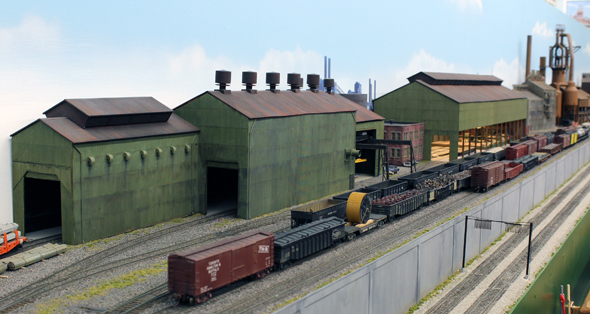 |
| The steel area of Hamilton as it is modeled by the HOMES group. |
 |
| TH&B power is seen in various scenes. |
 |
| Since some of the layout follows the Niagara escarpment a nice display is setup to show us how it was done. |
 |
| Some of the memorabilia just outside the dispatchers door at the HOMES layout. |
Sunday, 13 November 2016
North Dorset, Vermont - Tool House
 |
| The North Dorset tool house is seen being used on the WRD as the Middlesex Center tool and train order office. |
The tool house is 26' by 16' with a height of 12' and 17' at the peak. The tool house door is 8' by8' and is 4' in from the corner. There is a window centered at both ends. The trim looks dark so I assume the structure was once painted. The roofing is roll tar-paper in a dark colour. There is a brick chimney on the far side on the roof peak.
 |
| This is the view found on the Bethlehem Car Works web site for the N. Dorset section house. I have seen this photo before and is now offered by Bob's Photo and is dated 1947. The tool house was retired in 1954 and the station was retired in 1951 when it was moved and property sold. It is not clear in this view but the order board blades are hanging on the post just below the top signal. My guess they are applied when an operator was assigned here or the signal is already retired. |
 |
| On the WRD the Rutland style train order signal is active and the blades are installed at Middlesex Center. This scene looks different at the moment while the tool house gets refurbishing. |
North Dorset - Water Tank
Next to the station there was a covered water tank similar to those found in Maine. The interior water tank was 10' high by 16' in width inside a 20'9" by 20'9" building 20' high on the sides which has a peaked top. It sat on a 3' high concrete base. The notes record there are windows also and I would presume a door. This tank structure is noted as being novelty siding and painted. Most of the water tanks on the Rutland Ry.never saw any paint...might make a neat model...George Dutka
Saturday, 12 November 2016
TH&B Railway Historical Society Fall Meet
 |
| THB/OSR 51 was definitely the star of the show as far as many Society members were concerned. It is currently not in operating condition. |
The mainline of the Toronto Hamilton and Buffalo Railway stretched from Hamilton to Welland in the Niagara Peninsula region of Southern Ontario. Wholly owned by neighbouring giants Canadian Pacific and New York Central, THB totally relied on its connections with CP at Hamilton and with the Canada Southern subsidiary of NYC at Welland for furtherance to its terminals of Toronto and Buffalo respectively. Along with extensive industrial trackage in the Hamilton area, branchlines and running rights also took THB trains to Brantford, Waterford, and Port Maitland. Altogether, the TH&B represented a real "layout-sized" prototype.
 |
| The afternoon of Sept. 25,2016 was the time; the OSR shop at Salford, Ontario was the place. |
The Society's fall meet this year was held at the Ontario Southland's shop in Salford, Ontario. OSR units share the TH&B's maroon and cream colour scheme, and it is interesting to note that the first locomotive purchased by OSR president Jeff Willsie was ex-THB #51. The meet kicked of with an informative overview of OSR history and operations presented by VP Brad Joliffe. The OSR initiated operations 24 years ago as a contract switcher in the Mississauga area, and subsequently expanded to take over the Guelph Junction Railway, along with CP's Port Burwell and St. Thomas subdivisions. Along with its principal shop at Salford, there is a smaller facility at Guelph Junction. Most of OSR's collection of 35 first generation locomotives are stationed at these two shops, with a few others stored at Mt. Elgin and Tillsonburg.
 |
| Ex-CP Superintendent's car 24 is privately owned by Brad Joliffe and occasionally used as an OSR business car. |
After Brad's introduction to the OSR, attention turned to Society chairman John Spring, who presented a detailed talk on the CP connection with THB at Hamilton. CP forwarded THB/NYC passenger trains to Toronto Union Station using trackage rights on the CN Oakville Subdivision. Freights used the same route as far as Canpa, where they swung onto CP trackage.
Throughout the meet time, the Salford shops were fully open for inspection and photography. There was ample space to manoeuvre, as many of the locomotives had been pulled out into the yard and positioned for display. This was my first opportunity to attend a TH&B Historical Society meet, and I was greatly impressed by the turnout, content, and organization.
 |
| OSR 500, an S6 built by ALCo 11/56 (ex-Vancouver Wharves) snuggles up to UP 9444. Some contract work is performed on the property. Both the UP and the CITX locomotives are having electrical modifications performed by a London firm. |
 |
| Check the fine print and you will note that ex-THB 51 is actually an OSR unit. |
 |
| Here we see a nice assortment of maroon and cream units. 383 and 378 are ex-Soo GP7s, while 183 is an ex-Inco RS18. |
 |
| A full time crew of six employees work on the locomotives in the Salford shop. Many OSR hires are retired from CP, so the level of experience is high. The cocooned unit in the background is ex-CP 1594, soon to emerge as another nicely-painted OSR specimen. |
 |
| Compare the "real" THB paint scheme to the more recent OSR adaptation. #503 in the background is ex-CP 8029, an RS23(MLW 8/60). |
 |
| The venue of the actual meeting was the interior of the Salford shop. The screen is set up for John Spring's presentation. Brad Joliffe (wearing the reflective vest) is ready to introduce the OSR to more than 50 attendees. Can you imagine a better backdrop for a railroad meeting than the 6508? Is this the THB FP9 that never was? |
Friday, 11 November 2016
Tank Cars - HOMES
 |
| A trio of tank car that are now added to the WRJ fleet. |
 |
| Union Oil is a smaller capacity Proto 2000 tank car. I added a bit of Bragdon powder followed by a light coat of Floquil grimy black. |
 |
| A Proto 2000 Imperial Oil tank car (a larger capacity than the car above) is from an earlier era and a nice looking model that needed some missing portions of handrail added around the tank. One hose bag was also missing. A light over-spray is applied of grimy black and some Bragdon powders. |
 |
| Homgas was a popular propane car seen through New England back in the 1950's. I already have four of these Atlas models but this one looked too good to turn down. |
 |
| I airbrushed some grimy black down the center of the car and around the dome. I added a rust streaks down the weld seams and a bit around the trucks, stirrups and grabs. |
Flea Market Finds, November 2016
 |
| Here is an over-all shot of the two most recent additions to my roster. |
With Photos by George Dutka
The more time that George and I spend finishing and weathering rolling stock, the more I appreciate cars that have been nicely done by other modellers. Witness these two CB&Q 50' boxcars I acquired at last week's Kitchener Model Train Show. These cars are both factory assembled cars from the Life Like Proto 2000 line. They will fit in nicely with the other cars in my 1960s-era collection. Check out George's close-up photos.
 |
| Each car has its own weathering characteristics. Thanks to the unknown modeller who put in the effort to make these cars look so effective! |
 |
| The weathering on the cars is subtle, but effective. |
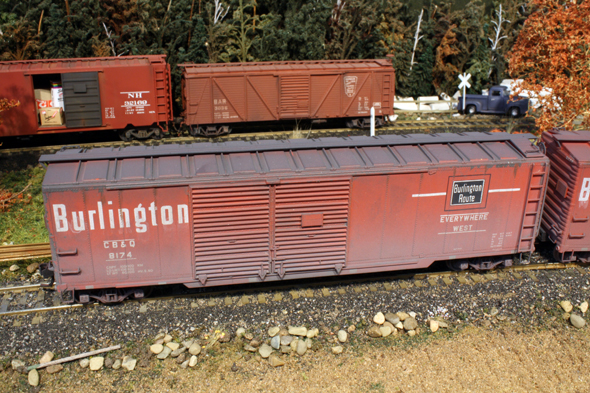 |
| Each roof was done differently. This one has a good amount of grimy weathering applied. |
Thursday, 10 November 2016
Ron Tuff's - British Columbia Railway
 |
| Two RDC's hold down the passenger work on Ron's layout. |
 |
| As one enters the layout room this is scene one views. A train curving around on a trestle which connects the two separate layout areas. Don Janes photo. |
 |
| Many of Ron's great looking trees set behind a covered water tank scene. Don Janes photo. |
 |
| A look into one of the yards on the lower level. |
 |
| Don uses a stool to get a good look at the second level. This portion has a lot of rock cuts cutting down on the amount of trees that will have to be made. |
 |
| All the rolling stock is modeled using prototype views as guides. |
 |
| Ron kit-bashed this Athearn caboose to come up with a good representation of the PGE prototype. |
 |
| These log cars a kit-bashed to follow the prototype from brass models. |
Helpful Modeling Tips
 |
| Ron Tuff's tree making process is seen from beginning (on left) to end. |
 |
| One can see once Ron has a handful finished how good they really look. Did I mention his mainline covers a 13' by 43' area on two levels with a good percentage of this being forest...a lot of trees still to be built one would think. |
Wednesday, 9 November 2016

Subscribe to:
Posts (Atom)