Tuesday, 11 February 2025

February 2025 - This and That

Don Janes is now running some more modern models around his Green Mountain Division. On the lead are two new Rapido offering. Don Janes photo.

Some photos that I grouped together for you to see this month...George Dutka  

A post card view of the station which once stood in Dutton, Ontario. My son lives there now and no tracks run through town now.
I came across a BC Rail unit on Feb 8 2025 here in London, Ont. This view is on track 24 along Pine St.

The engine came into town on train 509 from Sarnia. It is in the process of adding a multi level on a cut of cars.

City Taxi which is located in the back alley has the brick wall painted at one time green then white washed white some years later, What I wanted to show you are the two bottles on the loading dock which is now blocked in. When I was cleaning the 3-D dumpster from its mold all these little plastic pieces broke off the sprue which looked like milk and pop bottles. So I decided to use them on the structures. There are a lot of them attached to the sprue.

The back alley scene is getting near complete. 4 of the 5 buildings are now done.

An early morning view of a EB Amtrak departing Amsterdam, NY on Jan 23, 2025.

EB Amtrak passed the old freight house in Amsterdam, NY on Jan 23, 2025

The stone freight house is a very long structure with 19 freight doors on the roadside wall.

Monday, 10 February 2025

Some Extra Information!


Here is a bit of a follow-up on Peter's Throwback Thursday last week. This photo is from my son's Peter collection of PBLX 20145.  


This is a 4650 cu. ft. covered hopper car built by MIL 5/1979. Note that this is 100 cu. ft. larger than the similar appearing Canadian Wheat Board car. I have read that in order to entice US customers Canadian freight cars builders increased the volume of their designs. MIL made the car body longer, while NSC added a bump out section at the ends. Note how the trucks are also painted blue...Keith MacCauley. 

There was some questions regarding the roof arrangement on Keith's last post of UNPX 121700 series cars. Here is the drawings that were asked for...George


Sunday, 9 February 2025

Custom Painted Models - Perkins Road Depot


This year at Springfield I did not buy much and nothing that required construction. I have so many kits at home that probably will never get built in my lifetime. I always stop by David Barlow's table of custom painted or built rolling stock (Perkins Road Depot) which look really good. The prices are high but the work looks really nice. I decided to purchase two of his cars this year...I could build these myself but with so many kits already, I really never will, so acquiring the cars was a good option.

The first is a MEC pulpwood car which has a realistic looking load. There is a styrene backing added to the car before painting to help hold the load. The car is not really a show stopper...an older model with molded on grabs, but the load, paint, decaling and weathering is what makes it realistic. This model shows one you don't actually need all your cars to be top of the line kits.

The second car is a model of one of the three CV woodchip cars. I had seen his visions of these in the past using Tichy and Accurail cars. This one was done using a new Rapido model. There is no decals available for CV hoppers, David had the decals made for him by Highball Graphics. These woodchip cars were converted in 1969 and were in use till 1972 and 1976, so for only a short time. On my layout the lifespan will be a lot longer...George Dutka


This car was used by the Cascade Paper Company in Berlin NH. That is a five foot extension added to the hopper.


Saturday, 8 February 2025

Midwest Freight Car


by Keith MacCauley  

With only three major freight car builders (National Steel Car, Trinity and Greenbrier) currently in operation today, it’s easy to forget that well into the 1970’s there were more than a dozen railway rolling stock makers. While some of the defunct manufacturers were large and well known, such as Pullman Standard, there were a number of cottage industry type firms that contributed freight cars to the north American fleet; Magor Corporation, Greenville Steel Car and Berwick Forge come to mind. Among the more obscure, was Midwest Freight Car (MFC) located in Clinton IL. MFC was a niche builder that focused on short-run specialty cars, including flats, well cars, gondolas, hoppers, and covered hoppers. MFC was acquired by Portec in the late 1970s’s which in turn was sold to Thrall circa 1983/1984. Thrall was acquired by Trinity Industries in 2001.

In 1977 Procor was in need of a specific geometry 3,000 cu. ft. covered hopper car and turned to Midwest. The LO (AAR Class) covered hoppers were to be used to haul phosphate rock from Florida, presumably to a CIL facility in Canada for the purpose of fertilizer manufacture. CIL also had a large interest in sulfuric acid production (another fertilizer building block). A maximum height of 12’ – 6” was specified, most likely related to some type of origin loading apparatus geometry. The result was a rather low, lanky appearing car, and sixty-five were constructed in 1978; UNPX 121700 – 121764. Delivery was somewhat delayed by ongoing facility expansion taking place in parallel at the Clinton location. Purchase by a Canadian entity of a US company (Union Tank Car) was noteworthy at the time as this was long before the days of Free Trade and there would have been taxes and duties to be paid. Following service with CIL, the UNPX cars scattered to other lease customers, mostly hauling sand, roofing granules and other similar density commodities. The relatively small LO’s proved to be very durable with most serving some four decades before being retired/dismantled, or in some case sold off. While a number of sold/remarked cars carry on with their new owners, only one car from the original build is still in service with Procor. The ex UNPX cars are easy to spot as most still sport the large “PROCOR’ wordmark. A company condition of sale, rarely practiced or enforced, requires removal of the former identity. Textbook examples of prior identity are the small, former MFC built blue B&M covered hoppers with AEQX reporting marks which boldly display ‘BOSTON & MAINE’ between their exterior reinforcing ribs.

The UNPX 121700 series subject sent me down a bit of a rabbit hole and I dug out the construction file from our archives. It's a fascinating tale. We actually sent an inspector from Oakville to Clinton to keep an eye on things during production. Amazing to see how cheap travel expenses were back in 1978!


Friday, 7 February 2025

ITLA Back Alley - 20' 2 Floor Building

The 20' two story building is completed other than the roof details and trim.
I began the third structure in the ITLA back alley block. I thought I would show you how the brick and block work is painted and weathered...George Dutka 

Home Hardware red oxide primer is first applied.

Roberts brick mortar is applied unevenly.

I accented some of the bricks using a Micron 05 black pen. I normally just dab on black paint with a fine brush but I found this a bit easier and quicker to do.

The block wall is brush painted Ceramcoat rain grey using a brush.

I then highlighted some blocks using Ceramcoat Bridgeport grey. These two tones are very close to the same color so one could flip which one was the base coat.

A wash of AK rust steaks is coated on the blocks which darken the grout lines and stains the blocks a bit. To finish it off I will apply PanPastel raw umber shade over the entire surface, but lightly.


Thursday, 6 February 2025

Throwback Thursday - History Illustrated

SOO 111389 was caught at CP Quebec St in London, Ontario on August 20, 1995.
By Peter Mumby.  

As modellers, many of us appreciate a car that has its history clearly illustrated on its car body.  SOO 111389 is definitely one such car - the logo provides the identity of the previous operator and its faded nature implies an existence of twenty years or so without refinishing.  Little things like the attached ACI label also point to its longevity.  This photo dates to the mid-1990s which proved to be the calm before the graffiti storm which really picked up momentum in the late 1990s and eventually affected the majority of the covered hoppers on North American rails. 

Tuesday, 4 February 2025

Railfanning Springfield, Mass.

Power shuffled around the west end of the yard on January 24, 2025
Prior to the train show beginning...I was at the show to drop off my stuff on Thursday and again on Friday to check out how the layouts were going together. One enters through gate 1 which was a very short drive to a street which ends at the west end entrance of CSXT and an open view of that area. This is the West end of the yard and all is in full view. There was a number of railfans there on each stop I made...George Dutka  

Looking east from the roadway layover power is seen on the right while a WB train road power is getting ready to head over to its train.

A couple of the railfans that gather there on a regular basis.

A local switcher arrives on the scene. One could see more power down around the middle of the yard.

Lined up for a moment one could get a group shot.

A WB train was leaving as I arrived at the west end of the yard. This photo and the one below are from that train.


At the east end of the yard a short train of maybe 10 cars heads east just as I was heading to my hotel room. There is a bit of a pull off along the river where I tucked my car into.

Crossing the Connecticut River.

Monday, 3 February 2025

ITLA Back Alley Kit

There might be some extra details added on the roof later on and I have yet to decide if this structure will get a fire escape. It is a block building with a few rows of bricks up top.
I finally finished the second structure of 5 included in the ITLA test back alley kit. I began it in Springfield and got most of it done. Talking at the show really slowed me down. I have been sick since I got home (talking to Nick he and Steve also caught something). Sunday was the first time I felt well enough to work on the model once again...George Dutka

An overall view yesterday.

There are a lot of detail options that one can add.


Sunday, 2 February 2025

ITLA at Springfield 2025

RMC editor Otto stopped by the ITLA booth and took this photo of me. I was working on the back alley test build kit. From the sign up sheet the kit might do well.
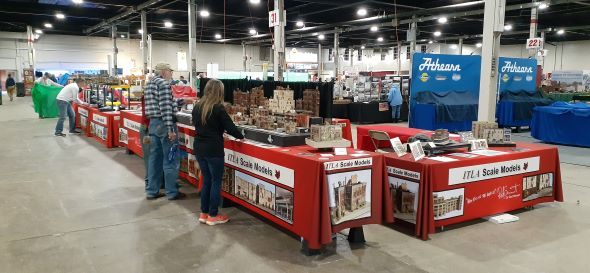
If you did not go to Springfield this year or missed the ITLA booth I thought I would share a few views I took of my time there. This year was the largest booth they ever setup. It was a full square with lots of finished models and three of us showing how you assemble kits and finish the models. There was a lot of questions directed at us. I think sales where good as most of the stock was gone by late Sunday with orders being taken for shipping once home.

I was surprised how many of the WRD blog followers stopped by the booth to say hello. It was great to meet you all and hear from you...those visits made my trip to Springfield special...thanks...George Dutka  


Above and below is another new test kit which is a city block scene. The back wall is the same one that will become the back alley flat. This model was built by Bryan Schilling  who also explained modeling building and weathering techniques. A fine modeler for sure.


Steve shows some of the painting techniques he uses on his builds.

Nick manning the sales area.

This was a huge display with lots for modelers to look at.


Sunday morning getting ready for the day.


Saturday, 1 February 2025

CN 1233


By Keith MacCauley   

Some additional background on yours truly. I grew up in the hamlet of Hannon. Hannon, while not a locality ever identified on any map, is situated above the escarpment on Hamilton Mountain (as referred to by ‘Hamiltonians’). A new housing development has somewhat put Hannon ‘on the map’, so to speak.

What became known as Canadian National’s Hagersville subdivision bisected Hannon south westerly, less than a mile from my parent’s house on Glover road. If the wind was in the right direction, I could distinguish the twelve cylinder 567 chant in a SW1200RS from the sixteen cylinder 567 drum of a GP9. The branchline was the former Hamilton and Northwestern Railway (H&NW) right of way linking Hamilton with the Lake Erie community of Port Dover. Descending the escarpment, the line crossed over the former T, H & B main line in the lower city swinging on to Ferguson Avenue to do some street running prior to entering Stuart Street yard on the Hamilton waterfront. Fate of the branchline? From daily except weekend service (Extra’s occasionally on Saturday’s), the former H&NW line experienced increasingly diminished usage into the early 1990’s and would eventually be lifted in 1993. Service south from Hamilton would be suspended in the late 1980’s following the lateral displacement of the Stone Church road overpass (in both directions!) by transport truck collision. Today, portions of the ROW between Hamilton and Caledonia remain as the ‘STONE CHURCH ROAD RAIL TRAIL’, to the north, and the ‘CHIPPEWA TRAIL’ to the south.

The attached photo (taken by my younger sister) is among my all-time favourite. Unfortunately, I did not record the date; most likely 1976. I recall that we rode our bikes to the adjacent St. George’s cemetery. My sister had my parent’s Kodak Brownie Hawkeye, while I manned a Radio Shack (remember them?) CTR cassette tape recorder. The cassette tape? Long gone. So too, SW1200RS CN1233; built 1956, retired 1990. She is shown delivering a CP bulkhead flatcar load of lumber to Penn Lumber. To access the Penn Lumber siding CN 1233 and a sister would have detached from their consist and used the RYMAL siding as a run around. Sobering to realize that this took place almost half a century ago!