Sunday, 22 February 2015

Ex-Lyndonville Frt. House - Prototype

I followed the line south from Newport to WRJ back on May 13, 1994 stopping at a good number of the station locations. The frt. house in Lyndonville was in really good shape.
After viewing the model, here we have a few views of what the prototype looked like when I stopped by Lyndonville back in 1994. I have also included a view by Gary Pembleton from his last visit not that long ago...enjoy...George Dutka

Gary took this photo of the frt. house on his last visit not that long ago.
ROW view May 13, 1994. Note the black and white station sign which still remained back then. Most of the platform is removed.
From this view I copied the ice cream sign and used it on Gary's model. May 13 1994. If one looks closely you can see the stone foundation it rests on.
Gary took a photo of what one might enjoy if they visited the frt. house these days.
A last look down the main line at the Lyndonville frt. house, 1994.

Saturday, 21 February 2015

Rock Crusher Relocation

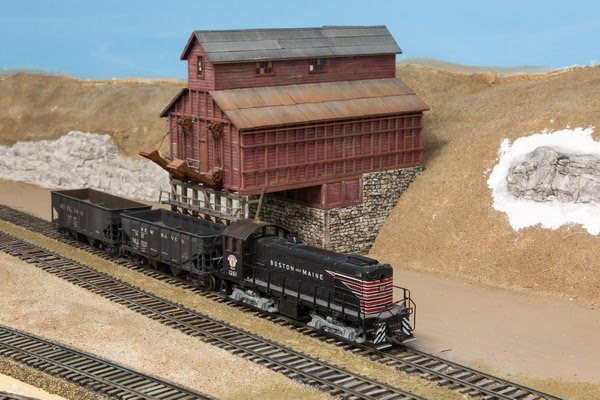
This is the quarry scene with the rock crusher as it appeared on my earlier version of the Green Mountain Division

An Old Structure Moves To A New Location..by Don Janes

    A few years ago when I tore down my original Green Mountain Division I had a lot of structures left over.  At first I felt that I had to use them on the new layout because I had spent so much time and money to buy and build them but as I got into the construction of the new layout I was finding that most structures weren't going to fit as I had hoped. I struggled with selling them even though I knew I wouldn't have a spot for most of them. I finally sold the Bellows Falls freight house and an engine house to George as he was going to model Bellows Falls on his new layout expansion and I was not. After that it wasn't so hard and since then I have sold quite a few of the older structures with a few more to sell.  One structure I wanted to keep was a rock crusher I had scatchbuilt.  I like the idea of a stone quarry with a large crusher and sorting building to add some operation to the layout. As you can see from the above photo it only had a small rail car capacity but was a busy little scene.
A CNR 2-8-0 hauls a freight by the quarry

The new location has two tracks, one for loads and another for empty car storage.  The center track runs through a rock cut to the hidden staging behind Waterbury. The foreground track is the visible mainline through Waterbury
      When I discussed placing this structure on the new layout George thought it might look a little more like a W.Virginia or Pennsylvania coal loader than a New England rock crusher but I think with the right scenery and signage I can make it look at home in Vermont.  I added two tracks this time for a little more operation and more car capacity.  There will be a section beyond the crusher where the stone is being dug out as well as a conveyor representing another quarry further away.

A couple of more shots of the roughed in crusher and open quarry area
       So far I have located the rock crusher, roughed in the scenery and carved the rock. I will have to do a little backdrop painting then start adding ground cover, trees and details to the scene.  I think the scene will also need a couple of smaller building like an office and storage shed.  I hope to make this a busy location on the layout which will provide local switching and pick-ups and set outs for mainline trains.  I have a little Rutland 70 Tonner that will likely be the quarry switcher.  It has a Loksound decoder and will sound great shuffling hoppers around the quarry
Rutland #500, a 70 Tonner will be the Quarry switch once the scene is complete.

X-29 Boxcars

My two finished Train Miniatures from decades ago will be joined shortly by another X-29. This time a Reading car. I have the car shell partly stripped down and ready for some details.
To date I have completed only two X-29 boxcars. One a Maine Central boxcar built from a Train Miniatures kit following an article in the Feb 1986 RMC. The second a CNJ boxcar following a Nov. 1988 RMC article. Peter and I decided to build a Reading X-29 each since my F&C Reading double door boxcar came with enough decals to do four cars. I am using a TM/Walthers car and Peter has a nice looking Red Caboose model on the go. This project is coming along well and should be done before the snow goes...George Dutka

The CNJ car was lettered with CDS dry transfers.
The doors are cut down and new door guides added. The roof walks are thin styrene although I used the stock roof corner boards.
I believe I used A line stirrups on this model. A wire bleed rod and wire grabs are also added.

Friday, 20 February 2015

Back in the Day

More than half the TVC members were present for this group photo.  London was George Dutka's home terminal and he was able to use work contacts to arrange a club tour of the Rectory St. roundhouse and servicing facility.  Standing on the steps was Jim McAllister.  Other members (left to right) included Dan Robilliard, Dave Harding, George Goddard, Fred Sachse, Larry Hugill, Peter Mumby, John Kanakos, George Dutka, and Bob Hannah.      Peter Mumby collection
Bob Hannah and the Thames Valley Central...by Peter Mumby

Once you start reminiscing, one thing invariably leads to another.  Case in point: in our Dec. 19th post on the Woodchip Train 25th Anniversary, the caption for CN 9526 north refers to the construction of the unit "in conjunction with our mutual friend, Bob Hannah."  That started us thinking about the other units in Bob's roster, and about how Bob, George, and I originally met circa 1980....and this is where the Thames Valley Central Modular Railroad Club comes in to the picture.

 The TVC was a London, Ontario area club which periodically showcased its modular set-up in local shopping malls.  The large oval display consisted of club-owned corner sections and member-owned side units.  The length of the display depended on how many members were able to participate in any particular show.  In addition, regular meetings at members' homes featured discussions, movies, and clinics.  The TVC still exists today, albeit in a much different form.  No longer modular in form, the group now displays a fixed-form portable layout, and has regular meetings in its Thorndale, Ontario clubhouse.

Doesn't every kid wish at some point to be a locomotive engineer?  On this fine fall day, Bob Hannah got to live out at least a small part of this fantasy.  Now, why do you suppose he chose to eventually build a model of CN 4507? Peter Mumby photo
Here is an over all view of the Rectory St. facility.  All of this railway infrastructure has now disappeared.  In its place today stands a large indoor soccer structure.  Peter Mumby photo
The TVC was originally established in the 1970s by Fred Sachse, and had developed the modular concept by the time George, Bob, and I joined.  My modules were built in partnership with Larry Hugill who worked as a welder at General Motors Diesel Division.  Larry provided us with a good connection with prototype happenings through GM.  Larry retired to Seaforth, and at last report was still working on a home layout.  Chris Martin, who worked for CN at the time, was another source of valuable prototype information at a time when I was just getting my feet wet in the hobby.  Today Chris is still a top notch model builder and a railfan photographer par excellence.  He is an authority on all things Penn Central (with special emphasis on the Canada Division). George Dutka at that time was a young engineman with CN, so you can see we had lots of opportunities to tend towards prototypical modelling practices.

TVC 5409 is a bit of a rare bird.  Prior to a club meeting at my house I volunteered to mount a clinic on decalling rolling stock.  Members wishing to participate provided me with a car in advance which I painted for them.  Decals were acquired from Champion Decals.  About a half dozen members participated.  This particular model is based on an old Lionel HO product.      George Dutka photo
Club member Dave Rodwell developed an interest in helping me with my tables at local train shows.  So too did Bob Hannah, and our discussions at train shows led us to do some model building together, including the CN 9526 mentioned earlier.  We each started a model, and I agreed to do the final paint work.  My (unfinished) model still languishes in a drawer near my work bench to this very day, but Bob's unit became an integral part of his HO locomotive roster.  Over the years Bob has continued to construct models, although not always of the railroad variety.  It was during one of his "non-railroad" phases that his locomotives became part of my collection.

Here we have a meet at the WRD diamond between engines built by Bob Hannah.  George Dutka photo.

The models featured in the following photos appear on George's WRD layout of today, although they were built more than thirty years ago.  The Thames Valley members were photographed at CN's Rectory St. shop area in October, 1982.


In this photo we see Bob Hannah's entire model locomotive roster as of the early 1980s.  This 1:87 fleet was based on Atlas and Athearn products.  Shown are CN GR-17h GP-9 number 4507, GS-9c SW-900 number 7235, and GF-430b GP40-2 number 9526.  Both prototypes and models were proudly assembled in London, Ontario.      George Dutka photo

Thursday, 19 February 2015

BEST Castings

Oh my god not there...I did put outhouses on the layout for a purpose...hard to keep those BEST casting in line...George Dutka

Casting are painted!


As one saw BEST castings are taking over the WRD...and when the layout now needs cleaning it really needs cleaning. Wondering the location of No. 2...George Dutka


Monday, 16 February 2015

Lyndonville Frt. House - Second Look

An aerial view of the Lyndonville, Vt. frt. house.
Here we have a good group of photos that gives one a good look at the N scale scene at several different angles. The scene was modeled on a piece of Gatorfoam...George Dutka

The only details on this diorama that were purchased are the single and group of tires which are available from Micro Engineering. I also added a figure supplied by Peter and a barrel, everything else I concocted from my HO scale scraps. I planned on using purchased skids but they are out of stock when visiting our local hobby shop...so all these are made from scrap stripwood.
The driveway is made of beach sand while the grass is a Scenic Express offering of 2mm short static grass. I leaned a few weathered boards here and there also. Some HO scale signs are added such as the no parking sign. The doors got a coating of red brick powders which made them stand out a bit better than the walls. At the far end one can see two additional blue signs that are from Wells River and Barton. As this frt. house is at the lines headquarters all this trash seems to show up here. I photocopied and reduced views of the originals.
This end view views some clutter and weeds next to the loading ramp. The tree is an N scale evergreen I use on my WRD layout as background scenery. The Lyndonville sign I photocopied from a late 1940's view of the original. This structure was also in the photo and showed one end of the building with white or cream trim while the other end had a darker red trim. I went with the white trim. The roofing at that time showed as dark gray, but I could not tell if it was shingles or tar paper.
The loading dock has some fresh lumber stacked and scattered below that is just 1 by 4" HO scale stripwood.
My Atlas weathered boxcar seems to fit in well in this view.
All around this structure I scattered newspapers which are reduced from HO scale papers I have. I was pleased how well they reduced to N scale. I just crumpled then up a bit before adding them to this scene.
I left all the doors open on the trackside side. I thought by adding a bit of details inside the doors the scene will become more interesting to view. The sacks are made from brown paper bags. The skids are stripwood and most of the cans are just plastic spur's cut into small pieces with some powders added. I added some stripwood lumber laying around and some brass wire as steel rods.
A final view of this old time freight house that still stands today.

Saturday, 14 February 2015

A Small Fleet of Boxcars

Group photo in White River Junction. We will take a closer look at these cars soon.
Before Peter Mumby left our last workday I took a group photo of his finished models that he just finished weathered a bit. They appear in the B&M end of my White River Junction yard. Now back to work...we still have a second batch that need completing...George Dutka

Lyndonville, Vt. Frt. House - N Scale

The finished freight house diorama which will eventually be added to Gary Pembleton's layout.
Creative Laser Design's N scale freight house

As mentioned earlier I did a swap with my friend Gary Pembleton. He gives me super trees and I get to go cross-eyed putting together a N scale craftsman kit. Not sure if N scale is for me. This whole project had to be done mostly with tweezers and a large magnifying glass. My fingers are just too big to handle all those tiny parts. And my eyes being 60 plus in age, do I have to say any more. I am pleased how the kit turned out being my first build in N scale. I did revamp an already built kit for Gary earlier this winter.

The Lyndonville. frt. house kit is a very basic kit and the price reflects that. The walls are nice, the windows are fine and a two part assembly. The doors are also nice. The freight doors, corner trim, roofing and chimney I did set aside replacing with what I though are better choices. The roofing is a solid styrene sheeting that was painted a mix of reefer gray with a touch of black added. It is dusted with dark rust Bragdon powder.

Although it is N scale I did add a good amount of bracing. None is included with the kit.
The windows and doors are nice fine details which add greatly to the finished model. The corner trim used is leftovers HO scale  from my Elwell General Store by BEST. The kit included corner trim that was twice this size or more O scale. Not good for N scale...the HO scale corner trim does look better.
The walls go together well but all needed to be braced. No bracing is included with the kit. I also had to add bracing to the platform as it had already began to warp. The walls and platform got  a coating of Hunterline weathering mix. The walls got a coat of Floquil tuscan red. Each wall got a different depth of colouring to reflect some weathering. I used the dark rust and reds powders from Bragdon to weather the walls. White chalk was applied to the trim and windows. The rest of the story is included with the photos...George Dutka


I have a heavy weight laying on the added bracing to the platform. The photo I took back in 1994 was useful in adding the  colour finishing.
The platform and base below is  lined up to see how all will fit. I think they are now ready for some glue. I still need to add the roofing and pilings before that though.
The styrene roof is in place.
The platform is finished with Hunterline weathering mix. I then added a bit of powder. The walls are Floquil Tuscan red over Hunterline stain. The chimney included with the kit is a block of wood. I decided to use a Sylvan Scale Model brick piling that was included in a HO scale house kit that my friend Bob passed along. It looks just right for N scale. A little filing and all is good.
The windows, trim and doors are painted with white chalk using this fine applicator. The colour gives the white a really weathered look...more so than using paint.
The doors on the end and rail side are modeled open. I added a few details that would be seen inside and around the doorway. The REA sign is reduced from the current Ely, Vt. station sign and the Lyndonville sign is a copy of the original station sign.
The ice cream sign I copied and added from a photo I took of the structure. The building  is currently used as an ice cream parlor. The Whiting and Hood's signs are reduced photocopies from decals I have.
An overhead view of the roadside side of the freight house. The kit did not include any freight door trim which I thought was needed. I made some from HO scale 2" by 3" which I had on hand. The freight doors are applied behind the wall and not in the openings to give them some depth. The steps are not found in the kit although the sides are. I just used HO 1"by 4" strips for this also.
The roadside doors I modeled closed and the walls on this side got a lighter coat of paint giving it a bit of a weathered look. On the model the base is concrete represented by painting the wooden base. On the actual structure the base is mostly stone. I will be posting some prototype photos shortly.

Friday, 13 February 2015

CNR Scale Test Car - N Scale

A bit of weathering toned down the shine on this model seen on Gary Pembleton's  N scale diorama.
While working in N scale recently Peter showed up with this neat looking scale test car. I added a bit of weathering and set it into the scene for a few shots. Boy this model sure looks good. If you are into N Scale, you might want to look into this car by Micro Trains Line...George Dutka

This is a nice looking N scale car offered by Micro Trains.
This is the other side of the top photo.