Friday, 19 May 2023

Building the MEC Section Shed

One window was boarded up a weathered Guilford sign is applied and some boards are pulled up. One can have a peek at the leftovers found inside the collapsed door
Here is a look at the construction, paint and weathering of my MEC style section shed...George Dutka

All the walls and parts are laid out ready for assembly. The wall corners will be all leftovers from other projects. 

I had placed the door as part open before I decided to model it as fallen in. Luckly the glue had not dried yet.

The roof is about to go on this structure. I made it from cardstock. Note I did add some bracing to the interior walls. Inside and out the walls began with a coating of Hunterline weathering mix.

I always have a supply of boards to add as detail or board up windows. The green tones found on the wall are a mix of tru-color MEC green and PanPastel green. The structure did not need a lot as I wanted the gray tone and some raw weathered wood to be showing through. I added nail holes once all the powders were applied.  

The area that will not have any tarpaper roofing got some paint weathering. More will be done with PanPastels once the roofing is applied.


Thursday, 18 May 2023

A Helper Engine on the WRD

CV passenger heading to WRJ.

I teamed up my Athearn CN B unit with another Athearn unit...CV GR17 4928 which is set up for passenger service. It is getting a workout heading north and south over the White River on the WRD...George Dutka  
Southbound with Bellows Falls not that far away.

Tuesday, 16 May 2023

Athearn B Unit


An Athearn B unit that was detailed back in the 1970's or early 1980's from my father in laws collection.

My father in law passed about a year and a half ago. Now that my mother in law passed also we are cleaning out the house. I was to take all his railroad collection which I did. He had some equipment that I already had but nice and some that is dated. 

I showed a bit of what he had to Peter Mumby mentioning I was thinking of selling off some of his older Athearn engines. He suggested I hang onto the B unit as it was well detailed but not well painted and decaled. I then thought it could make a good candidate to practice some weathering on.

The decals were not set well on the engine which I covered again with setting solution. There was a gloss coat applied, but so light and uneven that the setting solution did work on the decals. There was a couple small spots that one can still see if you look closely.

I added a flat finish then a coat of alcohol and India ink to the roof. From there I used acrylics to add a flaking edges followed by a dusting of PanPastel raw umber shade and Bragdon rust and soot. Some of the shades were lightly dusted on the sides. 

I should mention that the wheels are painted cinnamon brown and the trucks and lower frame area has AK rust wash and Vallejo rust texture applied before a light dusting of PanPastel colorless blender.

I think it looks a lot better than when I first pulled the engine out of the box...George Dutka

The engine before I began.

MIG polished metal was dusted on the grill while PanPastel colorless blender went on the trucks. The roof is well worn looking.

A well worn looking B unit. One can see there was a lot of details originally applied to the model.


Monday, 15 May 2023

MEC Section House - South Gardiner, Maine


A few views of the South Gardner, MEC section house now at the Boothbay Railway Village if someone was to model it...George Dutka  


Sunday, 14 May 2023

Snapshot - May 2023

On the overhead bridge looking east toward the yard by the tower. August 20, 1970
This months snapshot is two photos Gary Pembleton passed along. These were taken by Don Lang in Sarnia, Ontario back in the 1970's...interesting to see...enjoy...George Dutka  

Looking west towards the station. It appears Don was here to capture a steam movement seen in the center of the photo.


Saturday, 13 May 2023

Guilford - MEC Section House

A Guilford sign is seen on this side and the window is boarded up. Tar paper roofing has seen better days also.
This is one of the two MEC style section houses I built. This one has the door fallen in and the walls have a green tone applied such as some structures I have seen in late 1970's photos. Most of the paint is wearing off and heavily weathered. This structure will be added to the layout for when I move the era forward...George Dutka  

I put a MEC sign that is very worn on the other side. The window glass is broken and the blinds are torn.

The backside of the structure does not look any better than the front.


Friday, 12 May 2023

Tank Cars Sarnia - 1970


Two photos of the same tank car taken by Don Lang back in 1970 in Sarnia yard. Neat to see...will pass more along when I get them...George Dutka  


Thursday, 11 May 2023

This and That - May 2023

A form off a car at the Reclamation yard London, Ontario.
Here we have some extra material on a variety of topics...enjoy...George Dutka

Clare Gilbert of Sylvan Scale Models passed this tip for painting truck trailer roofing.
"I just read your article in RMC about working with plaster. Though I would let you know what I use for aluminum roofs on trailers. Varathane Metallic silver in an aerosol can. It sprays on beautifully and dries in no time. I have used it for years...Clare.  

MEC caboose 1155 is seen behind the load of coal being shoveled into a Maine two footer engine. Not sure of the date but 1920's era. Might make a good modeling project for a two footer interchange scene.
I had a nice visit with Don Janes and Jim Sloan on Monday May 8, 2023 in Sarnia. We had a chance to get caught up with each others modeling after a long winter. We are at Jim's in this photo. Oh when we went back upstairs there was at least 9 blue jays around the feeder in his back yard. His wife saw 14 earlier in the day. They are after peanuts in his bird feeder.
I had this photo of the Montrealer passed along to me not that long ago that I thought was interesting. Appears Amtrak is having problems and a CV and GT geep is being used.

The CPKC sign has been installed here in London not that long ago. It is amazing how many times the signage has changed in the last two decades.  

Tuesday, 9 May 2023

Red's Again!

Can you pick out the modeler in the crowd?
I had this other view of Red's from my Sept. 2016 visit. I was going to the National Narrow Gauge Show when I stopped by. I did not notice this at first but there is a On30 modeler in the lineup prior to Red's opening up for the day...George Dutka  

My version of Red's Eats that is a drop-in scene when the era changes.
Kevin Smith recently visited Red's, here is how it currently appears.


Monday, 8 May 2023

Updating a N Scale Mill

I used a Tichy spure to make the missing loading spout which is painted silver. The signage seen is from RailroadKITS in two sizes. White mortar wash is added to the bricks.

I showed you a few views of Gary's mill last week. I wanted it to look more like the paint has worn off and the signage has been there for years. The roofing was removed and replaced with two different colors of tar paper roofing. Gray and a dark red. This is made from construction paper that is spray coated then sanded off a bit after being cut into 3 foot strips.

To begin I coated the walls with a wash of Floquil grime. It was a jar that the paint was drying out and a lot of thinner needed to be added to turn it back into liquid. It works well for washes. PanPastel brown's and red chalk was lightly applied to were paint might still be, leaving some areas with no paint at all.

I reduced a group of my HO scale mill signs by half. I sanded the backs brushed them with PanPastel raw umber shade to dull down the edges and added a bit of AK rust wash and Vallejo rust texture. 

Some fine Woodland Scenic ground foam was applied were Gary had made vines originally. There is some brick as a base which is drybrushed with a brick red tone and highlighted with grout wash.

I think it is now a nice looking mill that Gary might want once again for his layout...George Dutka  

A wash of Floquil grime is added to the wood walls followed by a coat of India ink and alcohol. Dry brush MIG Rail Center red is dry brushed on the brickwork base.

Chalk and PanPastels are used to add the color to the walls.

I touched up the vines that Gary originally applied. The lower roofing is darker than the top. One can see the paint looks worn.


Sunday, 7 May 2023

B&M at White River Jct.


August 1983 finds B&M power on layover at WRJ. George Melvin copy

Another view of a B&M George Melvin slide I purchased...George Dutka  

Saturday, 6 May 2023

Work Zone

Work is well underway along the WRD. I set this scene up a few years back which can be a good place to park a work train. A B&M local slows to a crawl by the local gang. 
One of  areas that a switch was removed in the past had become a work zone on the WRD. I decided to use the rail, some ties and switch from that location to emulate a spur coming up. The workers are mostly Woodland Scenic figures...George Dutka     

Friday, 5 May 2023

N Scale Mill

The completed N scale feed mill which got some new signage and weathering. The roofing was changed out.
Gary Pembleton gave me this N scale mill a few years back to play around with. I finally got around to it. It was not a hard upgrade to do and I think it turned out well. I will explain what I did in a later post...George Dutka  

The mill as it looked before a bit of work.

The backside could use a bit of work also. 

The completed model.


Thursday, 4 May 2023

MEC Section House - Boothbay, Maine

 Trains were running all day during my visit on Sept. 7 2016.
On my visit to Maine in 2016 I visited the Boothbay Railway Village which has two foot gauge trains running throughout. Also on site are a nice group of railroad structures such as this MEC section house seen here that was moved from South Gardiner, Maine. This weeks Wordless Wednesday is of the Freeport station that is also located here...George Dutka   

Tuesday, 2 May 2023

My Workshop is a Mess!

My workbench is kind of a mess. There are a few engine projects on the go, and a few section sheds being finished off. The B&M section house on a box is a BEST Basic's kit that I finished a few weeks ago. I thought I had a spot for it on the layout but I felt it was too large. I have another spot in mind now. 
Normally when I have visitors the workbench is pretty organized but this was how it looked a week ago...a lot of projects in the works and kind of a mess. I am actually just getting back to the workbench more regularly now after a year of family and health commitments...George Dutka

Monday, 1 May 2023

Reclamation Yard - London, Ontario

Here is a tag from a car going to the Reclamation Yard, London
I recently was asked a few questions about  routing of scrap from the Reclamation Yard here in London. I never really paid much attention to were the metal went after we shoved the old equipment into the reclamation yard. But here is some of what I do know. There is a lot I have forgotten about the sand pit as we called it.

I on occasion worked the 0800 day yard in the late 1970's and 1980's that spent the day switching the Reclamation yard. I was on the spare board most of that time either as a brakeman or engineman. So my trips to the pit were spotty. I never worked the job regularly as it was a gravy job that the old timers always got. The job was called the sand pit job. I was told that before it became the Reclamation yard it was a sand pit operated by the CNR. I never really followed were the scrap metal went once it was cut up but I don't think any went to Zubick's scrap metal or London Salvage which is next to the CN yard office, at least by rail. They may have trucked some metal there. We did pull out loads of scrap metal in gondolas once the cars were taken apart. They all left on trains destined to Toronto. At Toronto the cars may have been sent to Hamilton or who ever offered the best price for the metal. 

Purchasing scrap metal from CN was done at the office inside the scrap yard. At one time my wife's uncle Bill Ball (late 1950's and 1960's) was the guy you dealt with. He liked his drink and the bigger the bottle that pass his way the better the price one paid for a load of scrap.

A lot of metal left by truck but I am not sure were it went. I know anyone could go there and buy scrap metal. I purchased a diesels engine air tank for the going weight price for use with my air compressor (I also sprayed automobiles on the side back then). There was a lot of waste such as wood from the outside braced wooden boxcars that was loaded into gondola's and sent to the Paris pit. Train 585 handled this chore which was our local night road switcher.

At one time the wood was sold to the public. Growing up in the west end of  London during my early years, many of the homes were built by Europeans after the war. My parents home was one of them. Not having much money this wood was a great deal. I can remember being in friends basements and seeing the CNR logo on the floor joists and also garages that did not get painted as the boxcar red was still in good shape. I would not be surprised to find renovation work showing some of the boxcar heritage.

The sand pit job was not a hard job. One began by gathering the cars required for cut up and shoving them into the yard. Basically down a long track through the middle of the yard where they cut up the cars by torch. We would then look for Walley the yard supervisor to find out what was coming out that day and if more gondolas or scrap cars would be required. Sometimes we had an afternoon spotting of more cars to be cut up.

There was a yard at the back with maybe 5 or 6 storage tracks. We normally put the gondolas there. We also move cars that were to be saved from cut up there. These cars maybe were already sold or held for speculation. One long tack and a shorter one were located near the middle of the yard which were the cars are torched. They just kept pulling the cars down with their equipment. No problem if there was a derailment, they just cut them up were they sat. There was a scale on the longer track. This long track was also used as the London yard "top end" switching lead. While working as an engineman cuts of cars of 40-50 would put me up to the office. Their was a derail so that kept the switching engine out of were the men were working.

While I was going through some of my papers from the pit I noted I had a yard checklist from the pit and also a tag off one of the cars that was scrapped...enjoy...George Dutka  
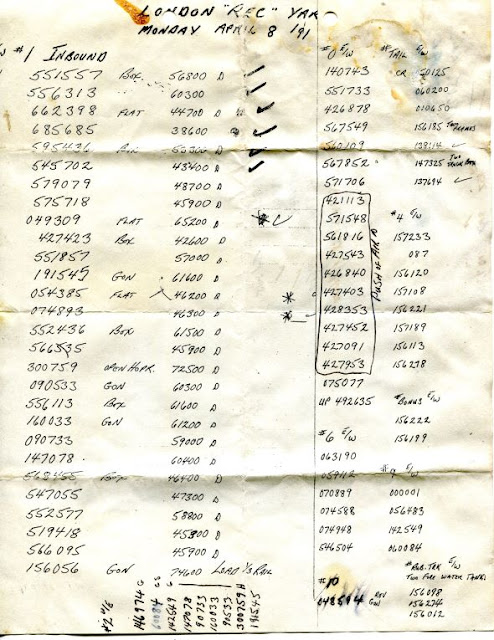
Check list from the pit.