
Wednesday, 24 April 2013

Sunday, 21 April 2013
Another Modelers Season Ends
 |
| In the WRD last post you viewed Peter Mumby's photos of the White River Division. Now here is my photos taken thirty years after my 1957 photo session in WRJ. We see a B&M Guilford engine coasting through the yard. Contemporary freight cars can be found laying over in the tracks once filled by 40' boxcars. |
on the White River Division
Last week Peter Mumby was over on two afternoons with his collection of what I call contemporary equipment and engines. We had a couple of long photo sessions that went really well. On day two of our photo shoot I also had my last layout visitor for the season in the midst of the train staging. He got a kind of "Back to the Future" look at the White River Division.
 |
| Peter Mumby is seen staging a double crossing of CN-CPR freight's during our two day photo shoot. Peter had brought over a group of engines and cars that could have been seen in New England during the 1980's. |
After two days during which I lost count the number of times I ducked under my duck under I realised why I could not move the day after. Last week was the last continuous running of the WRD. The duck under is coming out and my layout will become a point to point operation. I seem to only run the layout as point to point anyway. Most trains enter the layout from staging at one end and depart into staging at the other.
After a week of rain I can not find a leak from my window or wall in the layout room. I still plan to take a closer look next week at this area as I have already taken the trim off the window. Now that it is warm and once the ground drys a little I can also take a good look outside.
What I think might happen to my layout is WRJ station scene will become one end of the layout. The foreground main line through the countryside and the area that my drop in modules at West Barre are will be removed. The staging tracks will then become WRJ yard as I do not want trains leaving WRJ to head right into staging. The coal tower and sand shed will be foreground structures. One switch leading into staging at Bellows Crossing will be removed that has always bothered me. It is the only curved switch on the layout and gives me problems with passenger cars and long engines. The track will then become almost straight there. The yard area will be portable and removable since I may have to get at the wall in the future. Also if we move at some point I can then take the yard with me. In fact everything I will be building from this point forward will be removable and portable. Just over half of the layout will remain as is. At the opposite end from WRJ I will build a curve into the next room that will house Bellows Falls yard. This curved area I will try to include my drop in modules of Fairlee and West Barre.
 |
| A lone MEC engine heads out onto the causeway with a short freights. |
I guess I will have till next fall when I begin modeling again to figure things out. I am really glad to be getting rid of the duck under and I feel the White River Division will become a better layout in the process...George Dutka
 |
| Two leased geeps are seen heading out on the causeway which is my entry duck-under to the White River Division. One can see the other end of the layout which is Bellows Crossing. This is one of the last photos that will be taken of this portion of the layout. |
 |
| A WRD freight is lead by a duo of MEC U25B's out over the duck-under causeway. These two engines once operated on the WRD regularly before scenery and structures were added. You see they where originally mine. I had built and detailed them from Bowser models along with the MEC caboose seen in the other photo. Once I committed to DCC-sound I sold them to Peter Mumby so I would had extra funds to purchase 1950's era DCC sound engines. It has been at least 10 years since they have last been on the White River Division. |
Friday, 19 April 2013
Snapshot - April 2013
 |
| CP 4200 works a short freight through Northfield
Falls. This C424 model, based on an Atlas unit, was built by Charls
Gendron. |
in the 1980's
by Peter Mumby
photos by Peter Mumby
Many of you doubtless read George's recent post regarding a 1957 railfanning expedition on the White River Division. He sure was pleased to catch those BM F-2s, but I was amazed at seeing any of his photos at all from that era. He's either a lot older than he looks, or he was introduced to railways and f-stops when he was still wearing short pants. At any rate, fast forward 25 or 30 years and George has once again taken his camera's to White River Country - and this time he took me along! I guess urban renewal can't have been too big a factor in this part of New England. Most of the structures you noticed in the earlier photos hadn't changed much in appearance - even many of the 1950s vehicles still seemed to be in place! During our outing the sun shone down on us, and Lady Luck did as well. We caught B&M trains operating with Guilford/MEC power as well as leased BAR units. Central Vermont trains were using CN locomotives, but instead of the customary 9500s we found a pair of 5500-series GP38-2s. MLW C424 units are regulars on CP trains in this area, but we had the good fortune to find class unit 4200 which had been constructed with RS-18-style fuel tanks. It all made for a great expedition - an opinion I hope you'll share as the following photos unfold.
 |
| BAR units perform some local work at Bellows Crossing. These Atlas and Proto 2000 models, originally produced for our friend Luc Sabourin, have since migrated to Peter Mumby's collection. |
 |
| This view of the tail end of a CP freight was
lensed at the White River. The van is a Rapido model straight out of
the box while the 40' boxcars are based on Front Range models. 292516
was detailed and painted for CP-subsidiary Esquimalt and Nanaimo. |
 |
| CP 3081 is on the approach to Bellows Crossing. Sister unit 3050 was the 1000th locomotive produced at General Motors Diesel Division in London, Ontario. This milestone was recognised at a GMD roll-out ceremony in June 1986 which was attended by many dignitaries, including David Peterson, the Premier of Ontario. |
 |
| CN 5566 is
temporarily delaying road traffic near Barnett, Vt. This model was
built from an Athearn "blue box" kit with the addition of a Canadian
Prototype Replicas cab and a variety of Miniatures by Eric detail
parts. Sister unit 5560 (GMD 1973) was the first GM locomotive built
for CN with the wide (safety) cab. On CN these GP38-2s toil on today
as 4700s, their original number series having been given over to the
cowl-bodied SD60s. |
 |
| The White River never looked so good! How could that fisherman ignore activity like that? |
Thursday, 18 April 2013
Yesterday's Wordless Wednesday
I took that shot of the mailbox's near the covered bridges in Northfield Falls, Vermont. They are within sight of the CV tracks. Kind of a neat attempt of keeping ones old mailbox a bit longer using a second older one as a cover...George Dutka
Wednesday, 17 April 2013

Saturday, 13 April 2013
Early Spring in Vermont

Friday, 12 April 2013
Re-detailing a B&M RS-3
 |
| My re-detailed Atlas B&M engine heads over the White River |
B&M #1506
When I purchased two Bachmann RS-3's back in December which were both numbered 1536 that gave me three RS-3's with the same number. I had many years ago painted and lettered an Atlas RS-3 as 1536. I thought my Atlas engine could be a candidate for renumbering and detailing.If I painted out the 3 and added a 0 I could detail my RS-3 into a different looking B&M engine. Since I already have two DCC sound RS-3 engines operating on the layout it might be best to turn this engine into a dummy. I could use the engine as extra power on the shop track or on longer trains.
 |
| My Atlas RS-3 as it once looked while running over the White River Division for many years. When I added DCC to my layout the unit was retired to my storage cabinet till I decided what I would do with it. |
 |
| I had cut off the number board and filed the corner to accept a new number board. |
When I decided to change the number I needed to paint out the 3 and add a 0. I used Scalecoat B&M maroon #S2123. I then used the 0 from my B&M #5815H Accu-cals set. I was luck that the number stayed together as the set is quiet old. For the number boards I used Microscale CNR steam set 87-1019. Once all the decaling was done I gave the whole engine a coat of Floquil flat finish followed by some Bragdon weathering powders...George Dutka
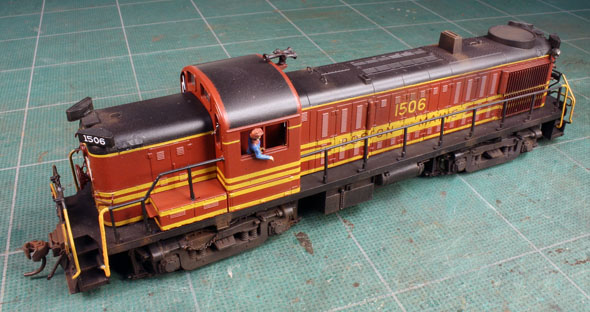 |
| The new number boards are added, the numbering changed and a coat of Floquil flat finish applied. |
 |
| My re-detailed RS-3 heads over the causeway towards Middlesex Centre. |
Wednesday, 10 April 2013

Monday, 8 April 2013
Weekend Odds and Ends
Last weekend I noted Dave Frary posted on his blog a title called Weekend Odds and Ends. This was a group of shots from his files which are just random modeling views from the past. I thought that made a nice easy post for Dave to put together. A few photos not related to each other but neat to see with a short comment. I think I may do that on random weekends especially through the summer when posts will be light. You can check out Dave's site through the links on the side of this blog...George Dutka.
Sunday, 7 April 2013
D&H Caboose
 |
| A finished D&H caboose is seen operating over the White River Division. This is a rare sight and only happens when trains are rerouted due to derailments. |
Adding a little D&H to the White River Division
#35974
#35974
Back in 2010 this Nickel Plate Product, D&H brass caboose came through Peter Mumby's used stock items. At $60 it was a great deal. I had seen the prototype cabooses first hand when I began railfanning in New England many years ago. I have always liked the D&H Ry., but it was just a road that did not fit into my scheme of things. I decided I could use it on occasion for rerouted D&H trains over the White River Division. The caboose has not seen much service on the WRD but at the price it was a good addition to my caboose collection.
 |
| My D&H van is seen before I began painting and detailing during the winter of 2010. |
Finishing this model was a fairly easy job. I know I used a photo of prototype caboose #35974, but can not find it at the moment. The only additions to the model are true scale #58 Kadee couplers and a conductor on the platform. My conductor is actually a Woodland Scenics engineman for the time being. The body was painted Floquil Tuscan red with a little mix of boxcar red added. The roof and under body is grimy black. I used Floquil D&RGW yellow which is a gold-yellow colour. I did not have a D&H caboose decal set but the Tichy decals for boxcars has all one needs to letter this model. The caboose got a light spray of Floquil grime on the trucks and underframe with a few spots of rusty chalk weathering...George Dutka
 |
| A D&H freight is departing Westminster Center on the White River Division en route to Rouses Point, NY. |
Saturday, 6 April 2013
Floquil Washes and Stains
I was going through the Walthers 2013 catalogue looking at paint colours and came across a new product available by Floquil. It is called Washes and can be found on page 842. To my surprise they also have Stains once again on page 841. Floquil had not made any stains in some time. I really liked using their Flo-Stains in the past and have to give these new products a try. My favourite was Driftwood and I see they have 14 stains including Oil & Grease and Mud. The Washes which I think are a water based Polly Scale product lists Walnut, Pine, Redwood, Barn Red and Blue and Black Washes along with many others. If you have tried these Washes and Stains please let me know what you think...George Dutka
Friday, 5 April 2013
Manitowaning, Ont.
 |
| Manitowaning waterfront as it looked during the summer of 2012. |
My Wordless Wednesday No. 20 photo featured a water scene. I had a few comments on the scene so I thought I best give you a little more details about the location and a few more photos.
The photo was taken last summer when I was up on Manitoulin Island. I had been sailing on a fiends boat for a week in the North Channel. During my drive back to the ferry that would take me back to the mainland I came across this neat scene in the town of Manitowaning, Ont The boat is the SS Norisle which is the retired ferry that was the connection to the mainland and many of the ports along Georgian Bay from 1946 to 1974. Along with passengers it also carried freight between locations. Today it is on display.
The town has a few interesting historical building including the two seen in Wordless Wednesday no. 20. The town has a nice old lighthouse and church. All these structures are candidates for modeling. Although Manitowaning is not a railroad location I feel it gives one inspiration for a nice waterfront scene...George Dutka


 |
| The Norisle in service. |

 |
| The Burns Wharf structure is now used as the local playhouse in season. |
 |
| The lighthouse is found up on the ridge and is typical of many found in the North Channel. |
Wednesday, 3 April 2013

Monday, 1 April 2013
Modeling Maine in Narrow Gauge
I started a new blog called Modeling Maine in Narrow Gauge. I have been a Maine Two Foot fan since I began modeling in 1979. The introduction to the blog fills one in with details. I wanted to stay away from posting my narrow gauge rambling in this WRD standard gauge blog. I have already done one post on my joint narrow gauge module with Peter Mumby here, and that is enough. I have re-posted the W&Q article from January in my new blog. Peter and I have finished the On30" W&Q modules and will at some point cover what we did.
For now in this new blog I plan on posting about 3 times a month. I may also have a Wordless Wednesday included from time to time and maybe a snapshot type of feature. Mainly I will cover what I have done recently plus some ramblings from the past 30 plus years of narrow gauge modeling. A lot has changed. The link to the blog is below and will also be found on my sidebar Links. So if you are interested in Maine narrow gauge modeling please feel free to take a peek from time to time...George Dutka
Modeling Maine in Narrow Gauge
For now in this new blog I plan on posting about 3 times a month. I may also have a Wordless Wednesday included from time to time and maybe a snapshot type of feature. Mainly I will cover what I have done recently plus some ramblings from the past 30 plus years of narrow gauge modeling. A lot has changed. The link to the blog is below and will also be found on my sidebar Links. So if you are interested in Maine narrow gauge modeling please feel free to take a peek from time to time...George Dutka
Modeling Maine in Narrow Gauge
Sunday, 31 March 2013
NEB&W Club on Facebook
I noted this week that the VTR Yahoo group posted a link to the Facebook page for the NEB&W layout of Troy, NY. It appears they are posting New England historical photos, plans and club layout shots on this site...you might want to check it out...George Dutka
NEB&W/Rensselaer Model Railroad Society Fanpage | Facebook
NEB&W/Rensselaer Model Railroad Society Fanpage | Facebook
Saturday, 30 March 2013
Snapshot - March 2013
Railfanning the White River Division
 |
| The mid day B&M passenger train arrives at Bellows Crossing with B&M's newly painted F-2 set A-B 4225. |
Newly painted B&M F-2's at Bellows Crossing
Back on a warm fall day in 1957 I railfanned the White River Division arriving at Bellows Crossing, Vermont prior to the arrival of the passenger train. It was early afternoon and I was hoping to catch the CV through freight, the mid day passenger train and if I was really lucky the local arriving back into town. As it turned out the local had already arrived and put the engine away. The engineman and conductor could be found discussing the days events out front of the station. The brakeman had already got into his shiny new red pickup truck and would shortly depart for home. I could hear the sound of what I thought were EMD's and hopefully F's coming from behind the trees. I had heard that a few B&M engines had been repainted in experimental schemes. Would I be lucky and see one today. As I scrambled to get my camera out the lead engine peeked out from behind the well kept station.
I had arrived just in time to catch a great shot of the old F-2's sharply painted in the new McGinnis blue and white scheme. What a find. These two engines were leading the mid day passenger train bound for Montreal from White River Jct. Today it had a express car and Pullman coach on the head end. Also included on the train was a CV coach and two American Flyer coaches, one from the B&M and the other from the NH. The train does make a short stop at the station giving me a minute to position myself just past the diamond for another view of the train and the neat looking engines. I did not have time to find the best spot for my photo as the train began to pull away from the station as I crossed the diamond, but any shot with this new paint scheme was a bonus. Although I missed much of the early days action seeing the newly painted F-2's made for another great visit to the White River Division.
 |
| I was just about to cross the diamond for a shot of the B&M trains departure when I thought this photo would also make a great view. |
 |
| The lead engine crosses the diamond at Bellows Crossing on the White River Division after a short station stop in town. |
15 freight F-2's came to the B&M in 1946. A few months later the B&M purchased three A-B sets with steam generators for use in passenger service. They were numbered 4224 A-B to 4226 A-B. In 1956 Patrick McGinnis took over the B&M and experimented with variations of a blue, black and white paint scheme. B&M 4225 A-B was a pair of engines that received this scheme. The F-2's left the B&M roster by 1966. The original 4225A was wrecked in 1949 and replaced with 4262.
The Model
A few years back Don Janes was able at acquire this pair of Athearn F units for me via ebay. Originally I had thought I had a pair on order but the engines never arrived due to some confusion. Anyhow I was happy to get the pair through Don which sound as great as they look and are fine running models. They both have factory DCC and sound included. I did not do much to the engines other than some light weathering to the trucks. I wanted these units to look new and lightly used on the White River Division...George Dutka
Thursday, 28 March 2013
50,000 Blog Views
 |
| A B&M freight passes the busy frt. house in Fairlee, Vermont bound for White River Junction. |
This winter I did about 75% less modelling than during the last two Modeler's Seasons. Working on our grand kids room (basement rec. room) and renovating my daughters kitchen took up most of my winter. I have had a big push on to get these projects done since returning from a short Florida vacation. I will be all done the first week of April and just in time for getting my boat into shape. I never thought I would be working 7 days a week from early morning till it gets dark once I retired but that is what it is taking the last few weeks to get the job done.The one bright spot about this is I did not spent any modeling money this winter, which is a first. The last time I was in a hobby shop was early December. I guess I should stop by and tell them I am still alive. The other good thing about this push to get projects done was Peter and I finally finished our On30 W&Q modular layout that was in the way of my basement renovation and had been sitting collecting cob webs for over a year. I will cover this project at some point.
So onward with fixing my basement leaks and seeing what I can come up with for my layout before next fall's Modeler's Season...George Dutka
Wednesday, 27 March 2013

Monday, 25 March 2013
Crossing the Connecticut River
 |
| The Southbound Vermonter is seen crossing the Connecticut River on Sept. 27 1996. Note the Vermonter baggage car is in tow. I crawled down the bank of the river that day to get a view looking underneath the covered bridge. The river was calm which gave me a nice reflection at the time. That morning there was no sunshine so this type of photo worked well with no sky visible. |
The photos included in this post compliment my first Snapshot posted back in January. I did revisit the Connecticut River covered bridge a couple more times back in the 1990's to get a few different angles of this scene. I was luck to actually get two trains a short time apart during the fall of 1996. In this post I have also added Dwight Smith's interesting notes about this location that was included in my original CVRHS Ambassador CV Snapshot...George Dutka
"The inclusion of USA's longest wooden covered bridge adds an additional point of interest to any photo. The bulky profile of Vermont's Mount Ascutney rises in the background of most views. Many do not realise that the bridge lies entirely within the State of New Hampshire, inasmuch as the Vermont state line is found on the west bank of the Connecticut River. Currently the bridge is used by NECR, Amtrak and PanAm."
 |
| I was luck to get a second chance to catch a train in a similar view. The Vermonter had a meet with NECR #323 not to far south of this location on Sept. 27, 1996. |
Saturday, 23 March 2013
White River Division...Off the Tracks
 |
| The area under the window is the point that I think water is coming through and running down behind the drywall and insulation. |
Water issues...
A few weeks back we had a very heavy rain that leaked into my basement. I did already have one spot that I need to repair by the furnace when I replace it this year. This has to be dug out from the outside. I also need to remove the central air unit (which also needs replacing) from the same location. This winter a second leak has appeared about 10 ft from the first. I store by sailboat gear under the layout. When I found a puddle under my gear I pulled everything out from under there and realised the water had run down the wall under the drywall. I also have a window in the same area which I am hoping is the problem. I can't really check this out till it warms up a little and the snow is gone. The insulation is wet meaning that section of the wall has to be removed and insulation removed before mold sets in. My staging yard and West Barre are located here and can not be just moved away...means that section of the layout and wiring needs to be cut out and removed to do the work.Replacing the drywall, mud and sanding is going to make a mess so a lot of the structures, trees need to be removed. My rolling stock gets put away for the summer so that is not an issue. I also have to figure out how I can blend in the sky colour as the whole layout room was painted at one time blending in the white and blue as I went along. Any touch ups will be really noticed.
This leads me to the next question. If I am pulling out a major section of the layout, replacing the furnace and piping should happen at the same time. The furnace piping runs over WRJ and West Barre. Do I re-figure the layout into one that does not have a duck under. I am finding I hate the duck under as I am getting older. I could leave half of the layout as is and rebuild the outside wall into a free standing area which does not need the wall for support. The layout would then become a point to point operation instead of the circle it is now.
One learns a lot about layout design and construction from issues like this. In the future I am planning on module design with the mini scenes to be removable such as I currently have at West Barre. I have keep my wiring simplistic which I will do once again. Lots to think about over the next month or two. I think the White River Division can be a much better layout if rebuilt but I do like what I have and will see if it can be fixed...George Dutka
 |
| As one can see the drywall and insulation is only applied down to the frost line or four feet from the ceiling. The concrete wall is seen under the layout. I attached the layout to the bottom supports of the drywall. One can see I have removed some of my sailboat gear to get a better look at the area under the layout and clean up the water. I also pulled off the plastic I have applied to the bottom of the layout. |
Subscribe to:
Posts (Atom)